For the first time, we are ending a quarter with more than just a development diary. Instead, we want to take a broader look at what has happened at ECSO CLOUD over the past three months, what changed behind the scenes, what went well, and where things did not go quite as planned.
Q3 2026 was an eventful quarter for us. We fundamentally modernized parts of our infrastructure, launched new features, restructured our services for business customers, and invested significant time into security, privacy, and the technical foundation for future products. Some of these changes are immediately visible to our customers, while others happened deep inside our infrastructure and will only show their full impact over the coming months.
At the same time, not everything went according to plan. There were technical challenges, setbacks, and situations from which we had to learn. We believe those moments are just as important to document as successful launches. A quarterly review should not simply be a list of achievements. It should provide an open look at where ECSO CLOUD currently stands and where we are heading next.
Managed Infrastructure becomes Enterprise
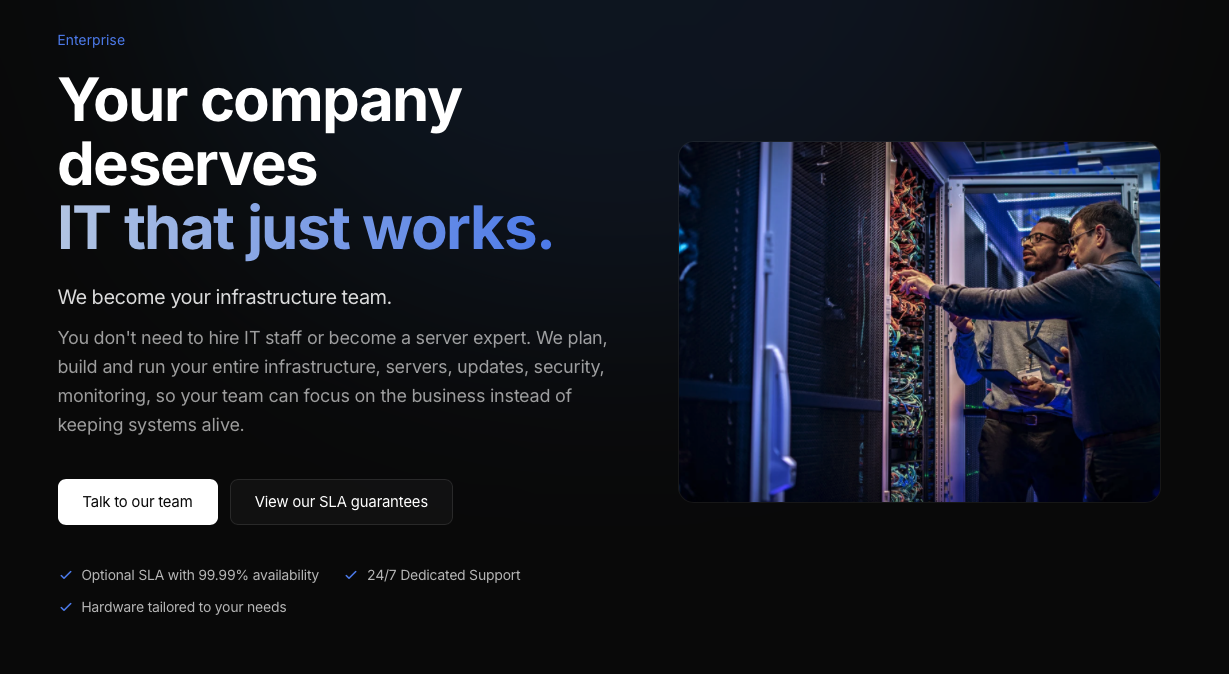
Our previous Managed Infrastructure service has been completely reworked and is now part of our new Enterprise division. The idea behind this change is simple: instead of limiting our involvement to individual managed services, we want to be able to support companies across much larger parts of their IT infrastructure.
For smaller and medium sized businesses in particular, maintaining an internal IT department can be difficult to justify. There is often enough work to require professional IT operations, but not necessarily enough to employ multiple specialists across infrastructure, networking, security, and system administration. This is where our Enterprise services are intended to provide an alternative. Depending on the requirements, ECSO CLOUD can take responsibility for individual systems, larger infrastructure environments, or potentially the majority of a company's technical operations.
Enterprise does not, however, mean that an existing IT department has to be replaced. Companies with their own technical teams can use us as an extension of those teams. We can take over recurring administrative work, support migrations and infrastructure projects, provide additional technical capacity, or handle tasks that would otherwise consume valuable internal resources.
As part of this restructuring, we have also made our Enterprise SLA publicly available. Companies can therefore review the service levels and commitments associated with our Enterprise services before contacting us. We want expectations around availability, support, and responsibilities to be transparent from the beginning.
A new generation of servers
One of the largest changes of Q3 happened where our cloud actually begins: the physical infrastructure underneath it. During the quarter, we shut down our previous locations in Chicago, Tokyo, and Cologne and consolidated our infrastructure into a significantly larger data center location in Cologne.
This consolidation represents more than just a change of facilities. It is also a strategic decision about the direction of ECSO CLOUD. Going forward, we are focusing our cloud infrastructure on the European Union. At the moment, our infrastructure is located exclusively in Germany, but towards the end of 2026 or beginning of 2027 we plan to start expanding into additional locations within the EU.
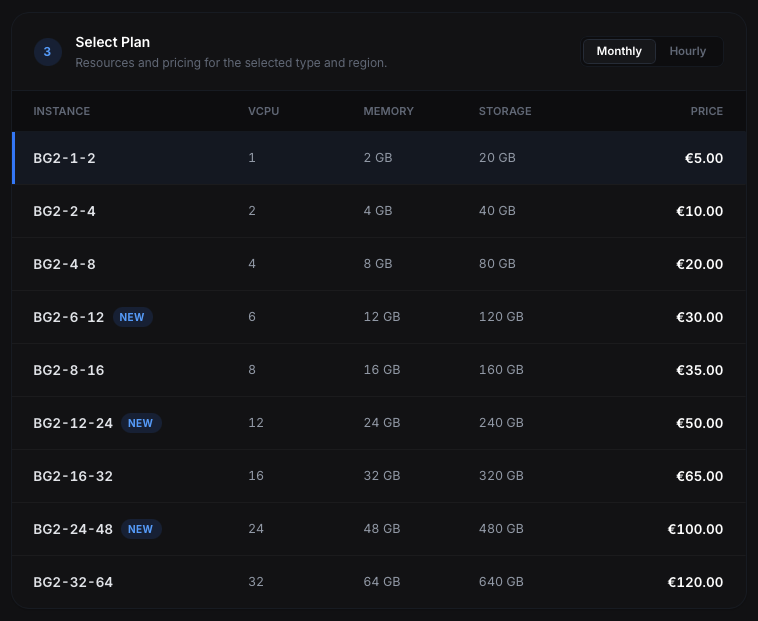
Alongside the location changes, we also introduced a new generation of physical servers. Our previous infrastructure relied heavily on AMD processors that were originally selected in part for their strong single core performance and suitability for gaming related workloads. As ECSO CLOUD has evolved, the workload profile of our customers has changed as well. Traditional cloud applications, databases, business software, virtualization, and enterprise workloads now play a much larger role.
Our new server generation therefore uses high performance Intel Xeon platforms that better match the workloads we currently operate and the infrastructure we want to build in the future. The new platforms also allow us to significantly increase memory capacity per physical server. With dual socket systems and a higher overall resource density, we can provide more compute and memory capacity while making more efficient use of the physical space available to us.
The upgrade also goes beyond CPU and memory. Network connectivity has been improved across the new systems, and our DDoS mitigation capabilities have been expanded to better protect the infrastructure against increasingly large and complex attacks.
Another important part of this generation is IPv6. New Cloud Servers are now provisioned with an IPv6 address in addition to their existing network configuration. IPv6 should no longer be treated as something that might become relevant at some point in the future. It is part of modern internet infrastructure, and we want our platform to reflect that.
Automatic language detection and system themes
Our infrastructure was not the only part of ECSO CLOUD that changed during Q3. We also spent a considerable amount of time improving the experience across our website, customer portal, and other web based services.
For a long time, the ECSO CLOUD website was available exclusively in English. The platform can now automatically detect the preferred language configured in a user's browser and display the appropriate translation when that language is supported. If a requested language is not yet available, the platform automatically falls back to English.
The same approach now applies to the visual appearance of our services. Our websites support both Light Mode and Dark Mode and automatically follow the system preference reported by the browser or device. Users can still override this behavior and select their preferred theme manually.
More importantly, these changes are no longer limited to the main ECSO CLOUD website. We have extended the same systems across our subdomains and started standardizing components that previously existed independently. Shared navigation can now recognize whether a user is signed in and provide additional options based on their account state.
This may sound like a relatively small visual change, but it is part of a much larger goal. We do not want ECSO CLOUD to feel like a collection of individual websites and tools that happen to use the same logo. We want it to feel like one connected platform, regardless of whether someone is browsing our website, managing infrastructure, or using another ECSO CLOUD service.
One Click Applications are now available
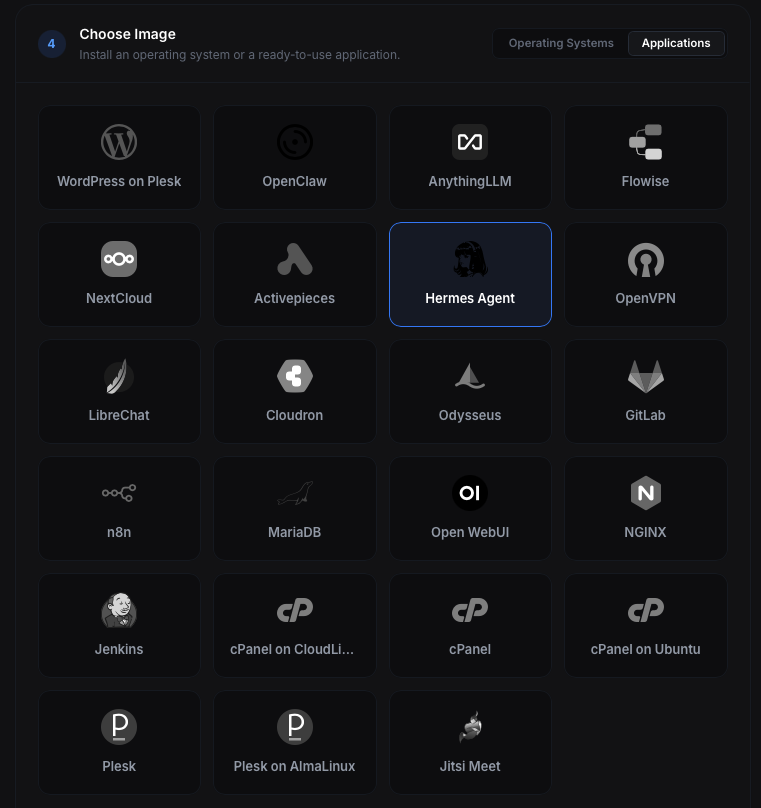
Setting up a Cloud Server should not always require starting with an empty operating system and manually installing every component. During Q3, we therefore introduced our new One Click Applications.
Customers can now select a preconfigured application when ordering a Cloud Server, installing a new system, or performing a reinstallation. The selected application is then automatically deployed as part of the installation process, significantly reducing the amount of manual setup required before the server can actually be used.
The current catalog already includes applications and platforms such as Plesk, GitLab, OpenClaw, AnythingLLM, Nextcloud, LibreChat, OpenVPN, NGINX, cPanel, and many more. The goal is not to build a static list of a handful of applications, but to continuously expand the catalog based on what our customers actually want to deploy.
Our One Click Applications are still in an active testing and development phase. Images and installation processes are regularly reviewed, maintained, and updated as new software versions become available. If an installation does not work as expected, customers can use the Feedback button inside the customer portal to report the issue directly to our team.
Over time, we want the application catalog to become an important part of the ECSO CLOUD experience. Whether someone wants to deploy a private cloud, VPN, development environment, AI application, hosting control panel, or collaboration platform, the basic infrastructure should be ready within minutes rather than requiring hours of repetitive setup.
A new look for our website, customer portal, and emails
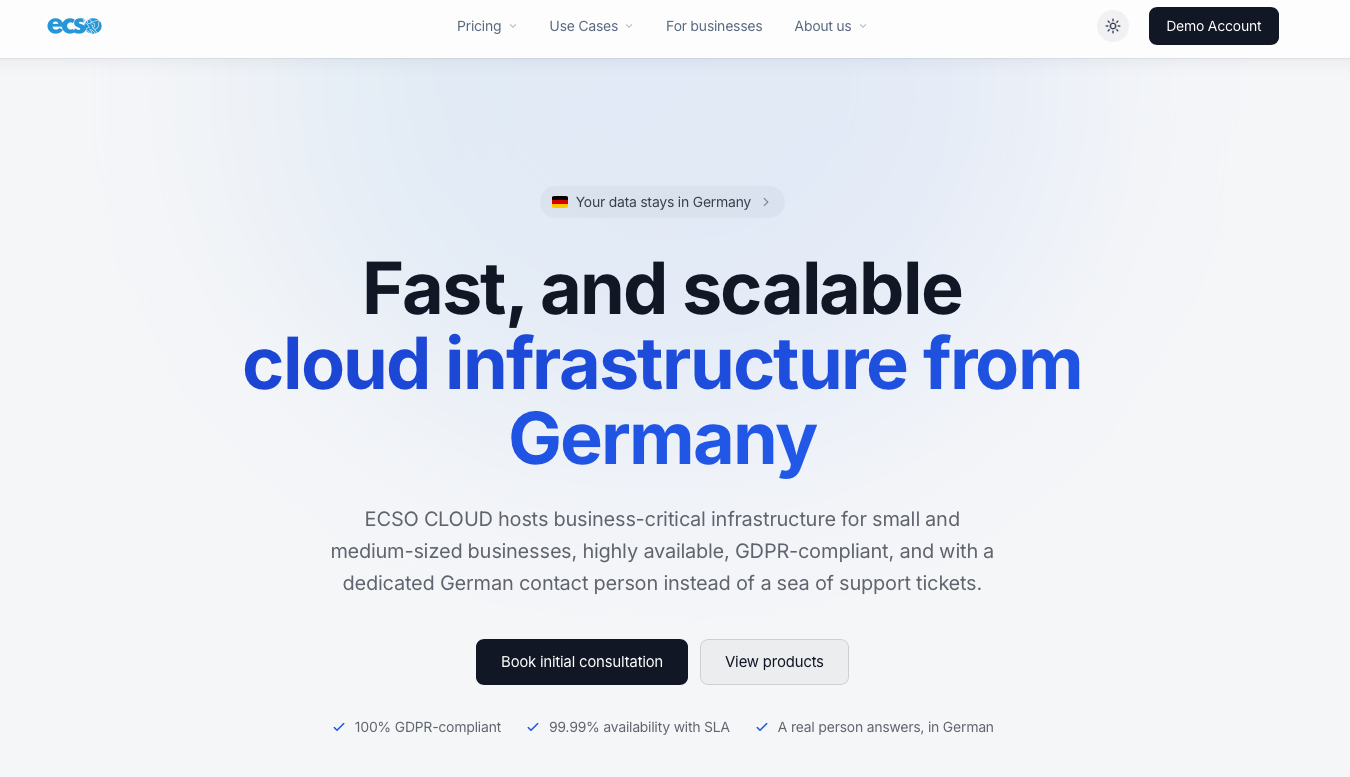
We already introduced major design changes during Q1 2026, but our work on the ECSO CLOUD platform did not stop there. During Q3, both our main website and customer portal received another series of visual and structural improvements.
The objective was not simply to make the platform look newer. We reviewed how information is presented, how customers navigate between different services, and how the individual parts of ECSO CLOUD fit together. At the same time, a significant amount of work happened behind the scenes, particularly around privacy and external dependencies.
We have continued reducing our dependency on US based services and reviewed the external providers involved in operating our platform. Where applicable, we have established the necessary data processing agreements with external processors and looked for opportunities to bring additional functionality into our own infrastructure.
One example of this is our new internal IP database. Some information that previously required requests to external IP lookup services can now be processed within ECSO CLOUD infrastructure. This reduces unnecessary external requests and gives us more control over how and where technical metadata is processed.
We have also reduced the number of cookies used across our services and further minimized the amount of information we collect where it is not required for operating the platform.
Our emails received similar attention. Both their visual design and content structure have been revised to make important information easier to identify and to ensure that communication from ECSO CLOUD feels consistent with the rest of the platform.
Improving the security of our infrastructure
Security was one of the most important areas of focus during Q3. Together with an external cybersecurity company, we performed extensive security testing across our web platform and parts of our underlying infrastructure.
The objective was to go considerably further than running automated vulnerability scanners. We deliberately approached our own systems from the perspective of an attacker. Applications were tested for vulnerabilities, authentication and permission models were challenged, potential privilege escalation paths were examined, and the isolation between cloud environments was actively tested.
This included attempting to break out of isolated environments and identifying situations where an attacker could potentially gain access beyond the permissions originally assigned to them. During the assessment, more than 30 potential vulnerabilities and security related improvement points of varying severity were identified.
Every finding was analyzed and prioritized, and the corresponding issues were addressed. We also performed retrospective reviews of available logs and other relevant information. Based on that investigation, we found no indication that the identified vulnerabilities had previously been exploited by third parties or that customer data had been exposed through them.
The most important result of this project, however, is not simply that a list of findings was resolved. Security testing like this is now intended to become a recurring part of how we operate ECSO CLOUD. Together with external security specialists, we will continue conducting assessments and reviewing our security concepts as the platform evolves.
No infrastructure remains static. New features, new software, and new systems can introduce new attack surfaces. Our security processes therefore have to evolve at the same pace as the infrastructure they are designed to protect.
Building infrastructure for GPU workloads
Another major project during Q3 was largely invisible from the outside. We started preparing both our physical infrastructure and our software platform for significantly larger GPU capacities.
Operating modern GPU infrastructure introduces very different requirements compared with traditional CPU based cloud systems. High performance GPU servers can require enormous amounts of power, generate considerably more heat, and reach hardware densities that make conventional infrastructure increasingly difficult to operate efficiently.
For that reason, the work involved much more than simply purchasing servers with GPUs. We expanded the electrical capacity available to our infrastructure and invested in additional liquid cooling capabilities. The relevant areas are being prepared so that high density systems can be operated with liquid cooling alongside traditional air cooled infrastructure.
This preparation is also intended to support future colocation products. Customers operating particularly power intensive hardware should eventually be able to benefit from the same infrastructure improvements.
The software side is being developed in parallel. Our platform has already been prepared for GPU based products, including the assignment of complete physical GPUs to individual systems as well as the technical foundation required for virtualized GPU resources and vGPUs.
Our long term goal is to offer GPU accelerated virtual servers directly through ECSO CLOUD. There is still work to be done before we reach that point, but the infrastructure expansion completed during Q3 was an important prerequisite for making these products possible.
And that's far from everything
Q3 2026 was one of the most extensive quarters for ECSO CLOUD so far. The changes described here represent some of the largest projects, but they are far from everything that happened during the past three months. Numerous smaller improvements were made across our infrastructure, internal tooling, customer portal, deployment systems, and operational processes.
At the same time, there were also problems. Not every change went according to plan, and not every decision turned out to be the right one on the first attempt. We experienced technical incidents and other situations that required us to review existing processes and make improvements. Those events are part of our development as a company just as much as successful product launches are.
We have documented relevant incidents separately and do not want to hide them behind the positive developments highlighted in a quarterly review. Additional information can be found in our blog and on our status page.
We have also introduced a comprehensive changelog inside the customer portal. Since September 2, 2026, it has continuously documented changes, improvements, and updates across our platform. This gives customers a much more detailed view of ongoing development than a quarterly article ever could.
This quarterly review is therefore not intended to be a complete changelog. Instead, it is a snapshot of where ECSO CLOUD currently stands and how the platform is evolving.
Q3 laid the foundation for several important developments that will continue throughout the coming months. We are working towards additional locations within the European Union, new cloud products, greater GPU capacity, a more unified platform, and infrastructure that can continue growing alongside our customers.
There is still a lot of work ahead of us, and there will undoubtedly be challenges along the way. But that is also what makes building infrastructure interesting. ECSO CLOUD today is already very different from what it was at the beginning of 2026, and many of the projects started during Q3 will shape what the platform becomes in 2027.
Thank you to all our customers, partners, and everyone else who continues to support ECSO CLOUD and provide feedback along the way.
We'll see you in Q4.